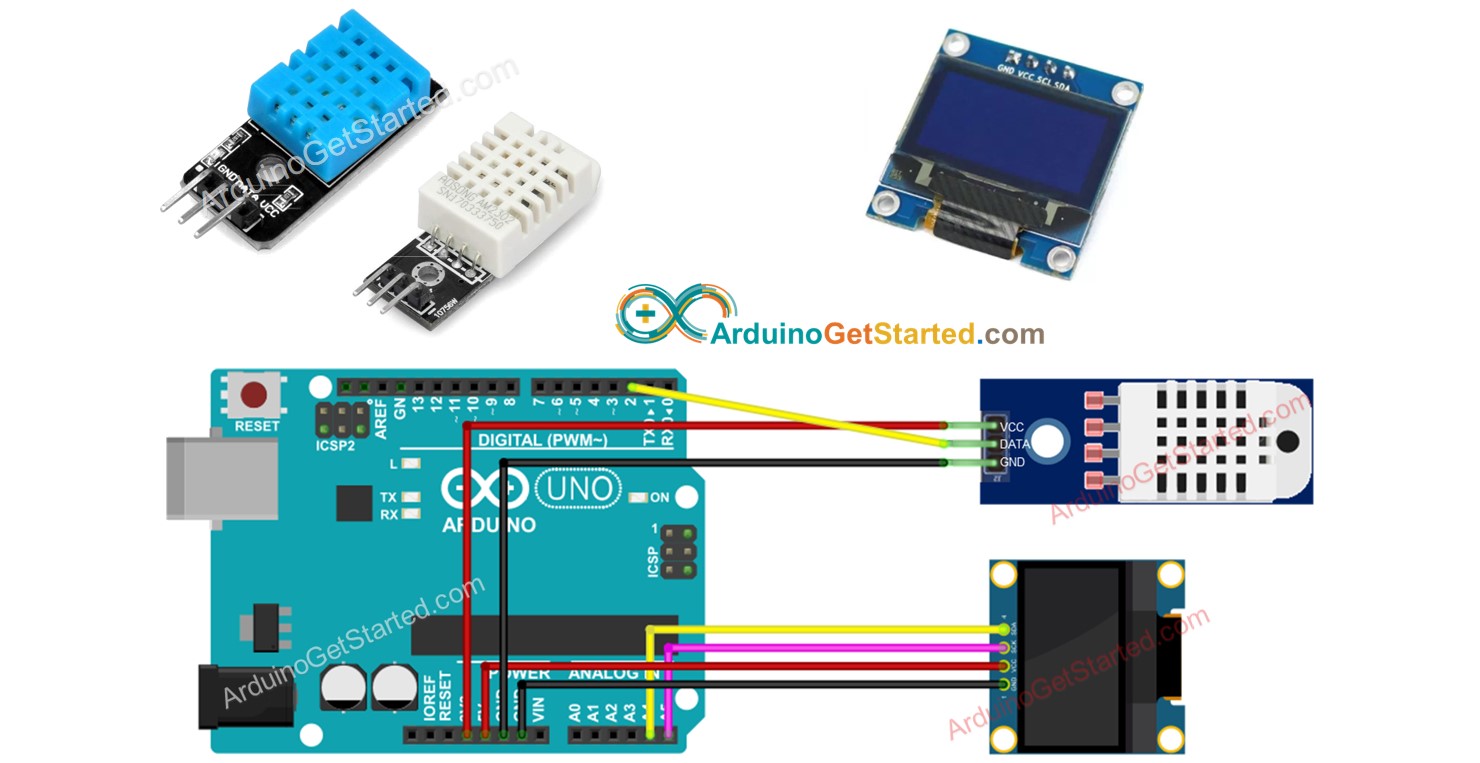
Arduino Cảm biến Nhiệt độ và Độ ẩm Màn hình OLED

Trong hướng dẫn này, chúng ta sẽ học:

Arduino cảm biến nhiệt độ và độ ẩm dht11/dht22 với màn hình oLED

Phần cứng cần chuẩn bị

1×Arduino Uno R3
1×USB 2.0 cable type A/B (for USB-A PC)
1×USB 2.0 cable type C/B (for USB-C PC)
1×SSD1306 I2C OLED Display 128x64
1×SSD1306 I2C OLED Display 128x32
1×cảm biến nhiệt độ và độ ẩm DHT11
1×dây jumper

You can use DHT22 sensor instead of DHT11 sensor.

1×(Khuyến nghị) Screw Terminal Block Shield for Arduino Uno
1×(Khuyến nghị) Breadboard Shield for Arduino Uno
1×(Khuyến nghị) Enclosure for Arduino Uno
1×(Khuyến nghị) Prototyping Base Plate & Breadboard Kit for Arduino UNO

Or you can buy the following kits:

1×DIYables STEM V3 Starter Kit (Arduino included)
1×DIYables Sensor Kit (30 sensors/displays)
1×DIYables Sensor Kit (18 sensors/displays)

Về màn hình OLED, cảm biến nhiệt độ và độ ẩm DHT11 và DHT22

Nếu bạn chưa biết về màn hình OLED, cảm biến nhiệt độ - độ ẩm DHT11 và DHT22 (cấu hình chân, cách hoạt động, cách lập trình ...), hãy tìm hiểu chúng trong các bài hướng dẫn sau đây:

Sơ đồ đấu dây

Arduino - Đấu nối LCD với mô-đun DHT11
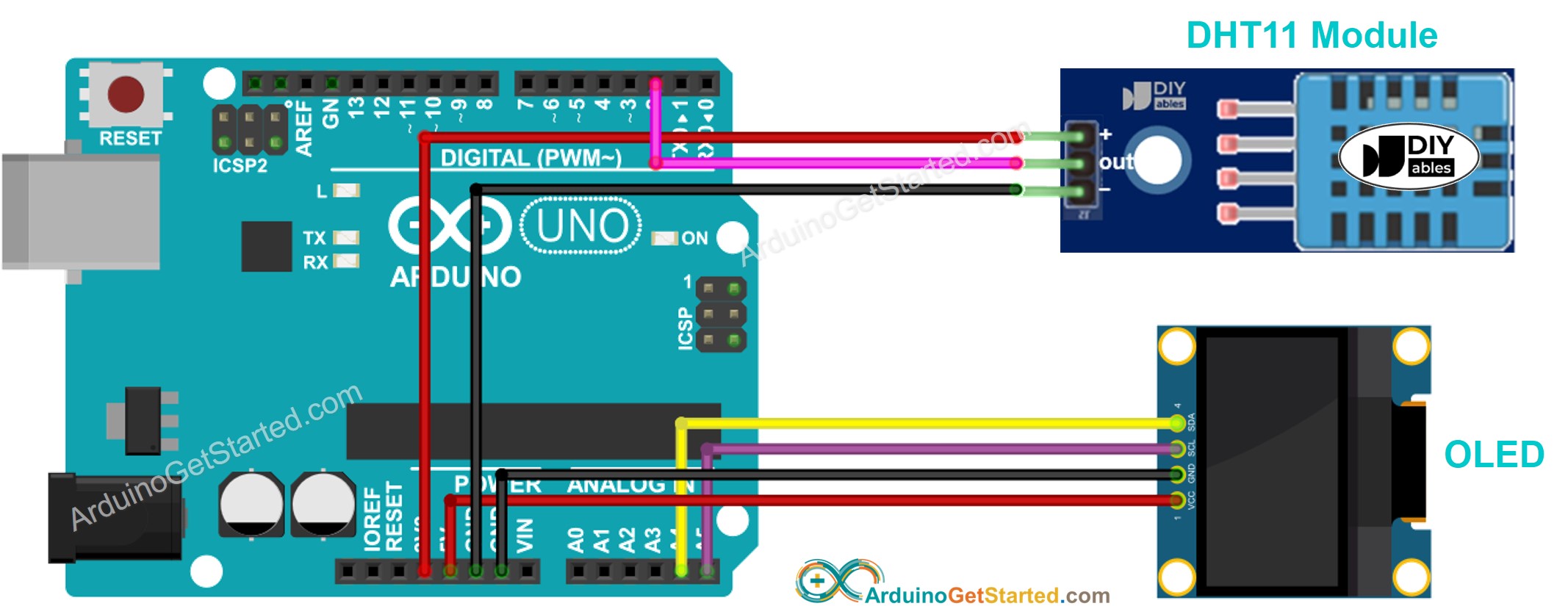
sơ đồ nối dây Arduino dht11 với oLED

This image is created using Fritzing. Click to enlarge image

Kết nối LCD với Arduino và Module DHT22
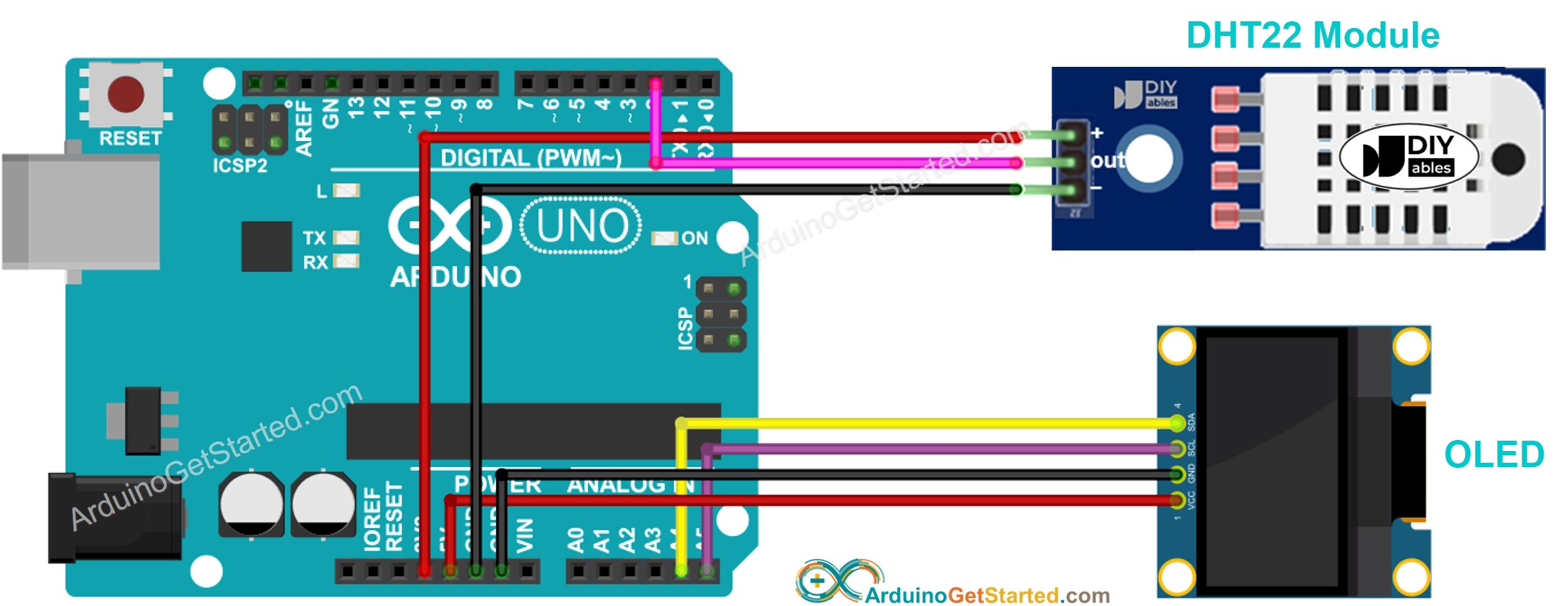
sơ đồ kết nối Arduino với cảm biến dht22 và màn hình oLED

This image is created using Fritzing. Click to enlarge image

Mã Arduino - Cảm biến DHT11 - OLED

/* * Mã Arduino này được phát triển bởi newbiely.vn * Mã Arduino này được cung cấp để sử dụng công khai, không có ràng buộc. * Để xem hướng dẫn chi tiết và sơ đồ kết nối, vui lòng truy cập: * https://newbiely.vn/tutorials/arduino/arduino-temperature-humidity-sensor-oled-display */ #include <Wire.h> #include <Adafruit_GFX.h> #include <Adafruit_SSD1306.h> #include <DHT.h> #define SCREEN_WIDTH 128 // OLED display width, in pixels #define SCREEN_HEIGHT 64 // OLED display height, in pixels #define DHTPIN 2 // pin connected to DHT11 sensor #define DHTTYPE DHT11 Adafruit_SSD1306 oled(SCREEN_WIDTH, SCREEN_HEIGHT, &Wire, -1); // create SSD1306 display object connected to I2C DHT dht(DHTPIN, DHTTYPE); String temperature; String humidity; void setup() { Serial.begin(9600); // initialize OLED display with address 0x3C for 128x64 if (!oled.begin(SSD1306_SWITCHCAPVCC, 0x3C)) { Serial.println(F("SSD1306 allocation failed")); while (true) ; } delay(2000); // wait for initializing oled.clearDisplay(); // clear display oled.setTextSize(3); // text size oled.setTextColor(WHITE); // text color oled.setCursor(0, 10); // position to display dht.begin(); // initialize DHT11 the temperature and humidity sensor temperature.reserve(10); // to avoid fragmenting memory when using String humidity.reserve(10); // to avoid fragmenting memory when using String } void loop() { float humi = dht.readHumidity(); // read humidity float tempC = dht.readTemperature(); // read temperature // check if any reads failed if (isnan(humi) || isnan(tempC)) { temperature = "Failed"; humidity = "Failed"; } else { temperature = String(tempC, 1); // one decimal places temperature += char(247); // degree character temperature += "C"; humidity = String(humi, 1); // one decimal places humidity += "%"; } Serial.print(tempC); // print to Serial Monitor Serial.print("°C | " ); // print to Serial Monitor Serial.print(humi); // print to Serial Monitor Serial.println("%"); // print to Serial Monitor oledDisplayCenter(temperature, humidity); // display temperature and humidity on OLED } void oledDisplayCenter(String temperature, String humidity) { int16_t x1; int16_t y1; uint16_t width_T; uint16_t height_T; uint16_t width_H; uint16_t height_H; oled.getTextBounds(temperature, 0, 0, &x1, &y1, &width_T, &height_T); oled.getTextBounds(temperature, 0, 0, &x1, &y1, &width_H, &height_H); // display on horizontal and vertical center oled.clearDisplay(); // clear display oled.setCursor((SCREEN_WIDTH - width_T) / 2, SCREEN_HEIGHT / 2 - height_T - 5); oled.println(temperature); // text to display oled.setCursor((SCREEN_WIDTH - width_H) / 2, SCREEN_HEIGHT / 2 + 5); oled.println(humidity); // text to display oled.display(); }

Hướng dẫn từng bước

  • Mở Arduino IDE trên máy tính của bạn.
  • Điều hướng đến biểu tượng Thư viện ở thanh bên trái của Arduino IDE.
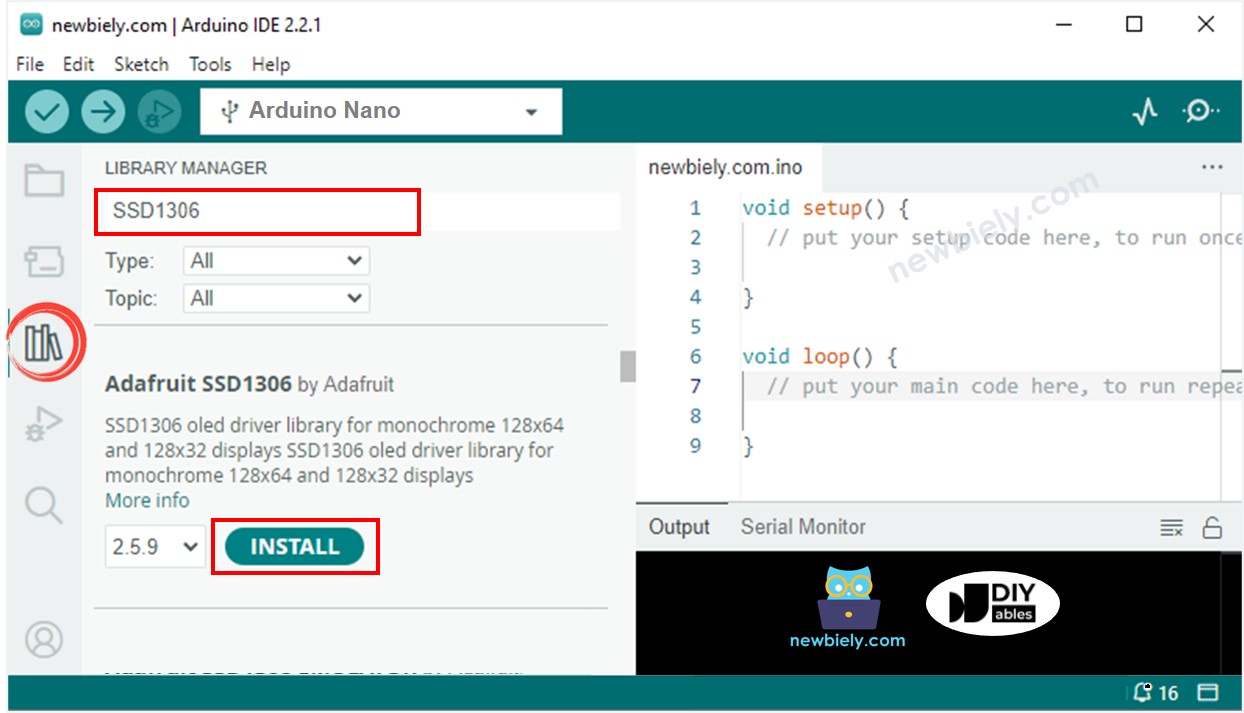
  • Tìm kiếm “SSD1306”, sau đó tìm thư viện SSD1306 của Adafruit
  • Nhấn nút Cài đặt để cài đặt thư viện.
thư viện oLED cho Arduino
  • Bạn sẽ được yêu cầu cài đặt thêm một số phụ thuộc thư viện khác.
  • Nhấp nút Cài đặt Tất cả để cài đặt tất cả các phụ thuộc thư viện.
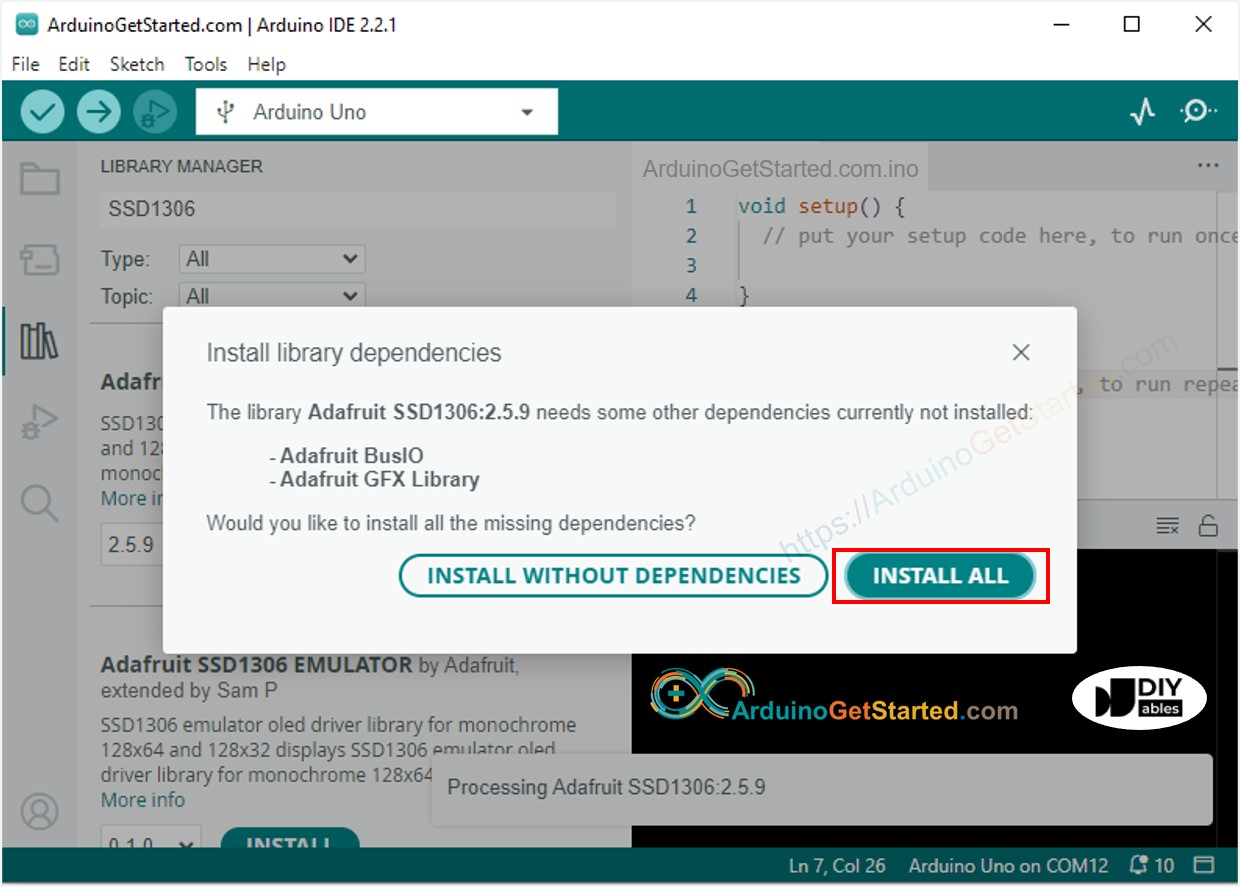
thư viện cảm biến gfx của adafruit cho Arduino
  • Tìm “DHT”, sau đó tìm thư viện cảm biến DHT của Adafruit
  • Nhấp vào nút Cài đặt để cài đặt thư viện.
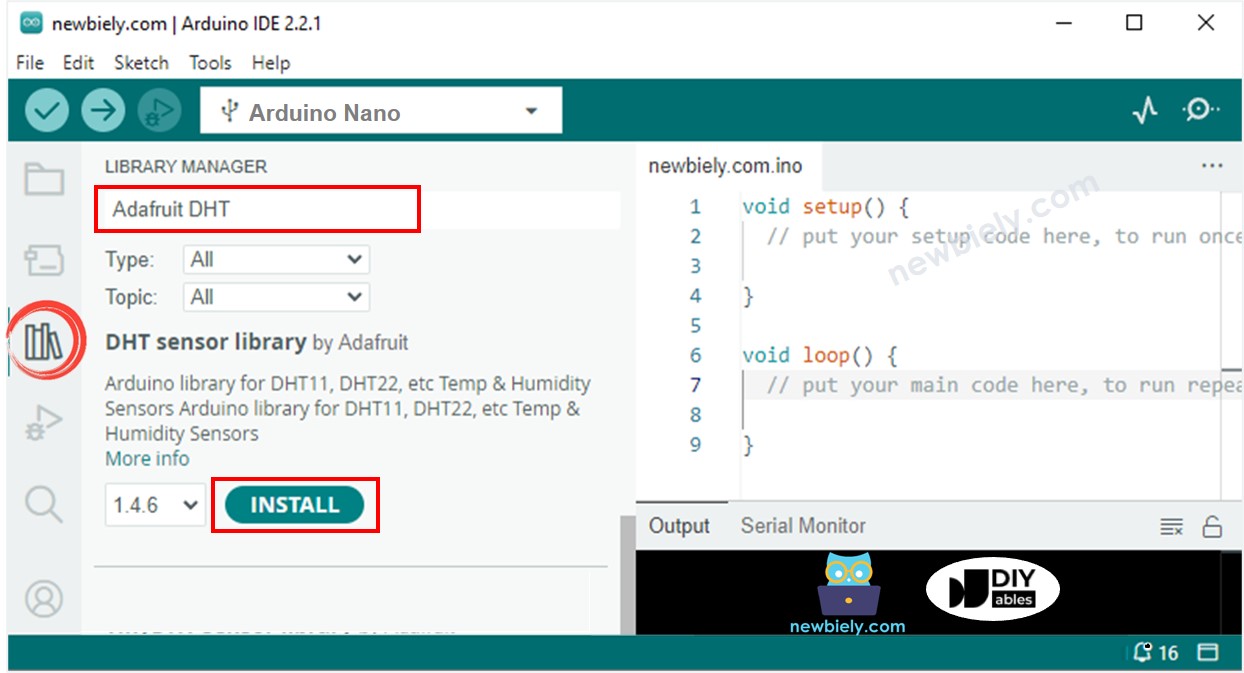
thư viện cảm biến dht cho Arduino
  • Bạn sẽ được yêu cầu cài đặt một số phụ thuộc thư viện khác.
  • Nhấp vào nút Cài đặt Tất cả cho tất cả các phụ thuộc thư viện.
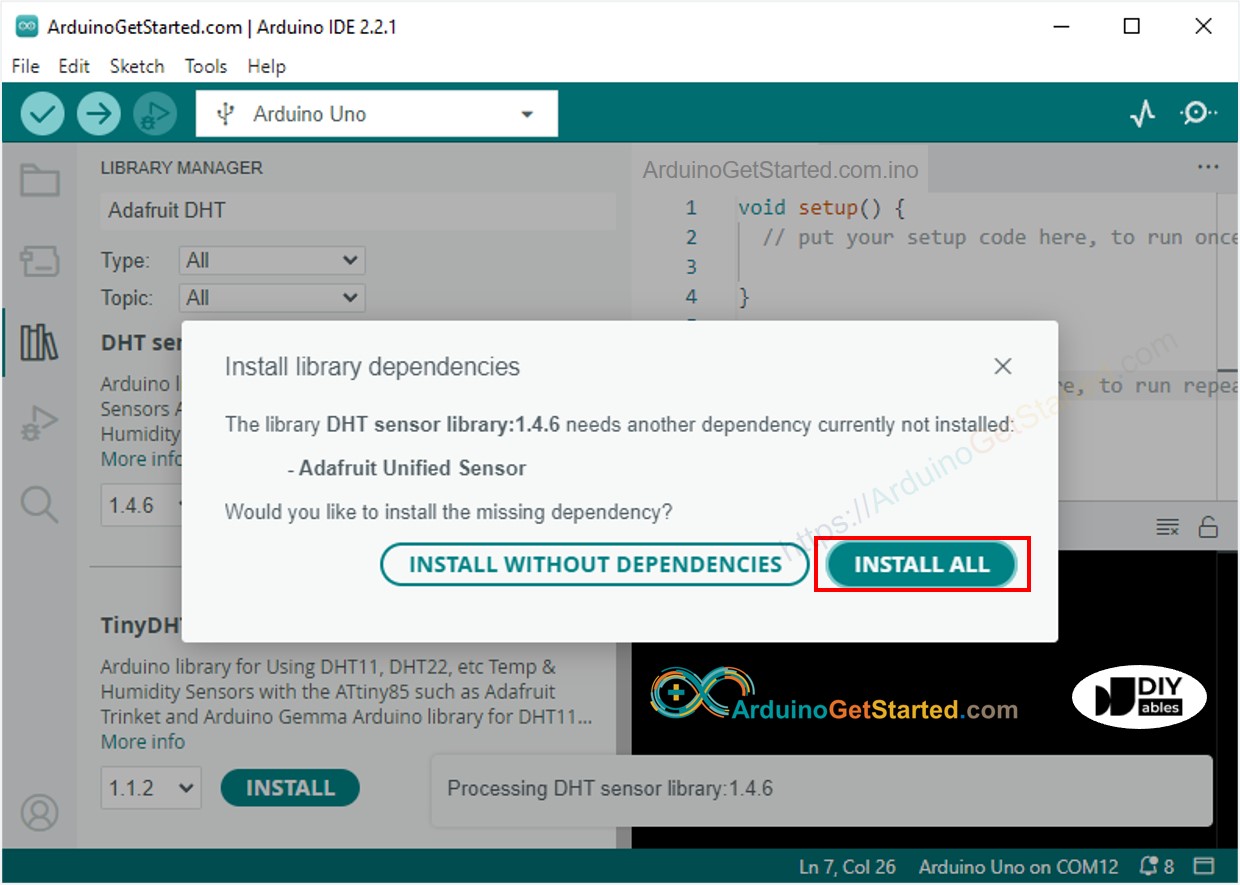
thư viện cảm biến thống nhất của adafruit cho Arduino
  • Sao chép mã phía trên và mở bằng Arduino IDE
  • Nhấp nút Tải lên trên Arduino IDE để tải mã lên Arduino
  • Đặt cảm biến vào nước nóng và nước lạnh, hoặc nắm cảm biến bằng tay
  • Xem kết quả trên OLED và Trình theo dõi Serial

※ Lưu ý:

Đoạn mã trên tự động căn giữa văn bản theo chiều ngang và chiều dọc trên màn hình OLED.

Mã Arduino - Cảm biến DHT22 - OLED

/* * Mã Arduino này được phát triển bởi newbiely.vn * Mã Arduino này được cung cấp để sử dụng công khai, không có ràng buộc. * Để xem hướng dẫn chi tiết và sơ đồ kết nối, vui lòng truy cập: * https://newbiely.vn/tutorials/arduino/arduino-temperature-humidity-sensor-oled-display */ #include <Wire.h> #include <Adafruit_GFX.h> #include <Adafruit_SSD1306.h> #include <DHT.h> #define SCREEN_WIDTH 128 // OLED display width, in pixels #define SCREEN_HEIGHT 64 // OLED display height, in pixels #define DHTPIN 2 // pin connected to DHT22 sensor #define DHTTYPE DHT22 Adafruit_SSD1306 oled(SCREEN_WIDTH, SCREEN_HEIGHT, &Wire, -1); // create SSD1306 display object connected to I2C DHT dht(DHTPIN, DHTTYPE); String temperature; String humidity; void setup() { Serial.begin(9600); // initialize OLED display with address 0x3C for 128x64 if (!oled.begin(SSD1306_SWITCHCAPVCC, 0x3C)) { Serial.println(F("SSD1306 allocation failed")); while (true) ; } delay(2000); // wait for initializing oled.clearDisplay(); // clear display oled.setTextSize(3); // text size oled.setTextColor(WHITE); // text color oled.setCursor(0, 10); // position to display dht.begin(); // initialize DHT22 the temperature and humidity sensor temperature.reserve(10); // to avoid fragmenting memory when using String humidity.reserve(10); // to avoid fragmenting memory when using String } void loop() { float humi = dht.readHumidity(); // read humidity float tempC = dht.readTemperature(); // read temperature // check if any reads failed if (isnan(humi) || isnan(tempC)) { temperature = "Failed"; humidity = "Failed"; } else { temperature = String(tempC, 1); // one decimal places temperature += char(247); // degree character temperature += "C"; humidity = String(humi, 1); // one decimal places humidity += "%"; Serial.print(tempC); // print to Serial Monitor Serial.print("°C | " ); // print to Serial Monitor Serial.print(humi); // print to Serial Monitor Serial.println("%"); // print to Serial Monitor } oledDisplayCenter(temperature, humidity); // display temperature and humidity on OLED } void oledDisplayCenter(String temperature, String humidity) { int16_t x1; int16_t y1; uint16_t width_T; uint16_t height_T; uint16_t width_H; uint16_t height_H; oled.getTextBounds(temperature, 0, 0, &x1, &y1, &width_T, &height_T); oled.getTextBounds(temperature, 0, 0, &x1, &y1, &width_H, &height_H); // display on horizontal and vertical center oled.clearDisplay(); // clear display oled.setCursor((SCREEN_WIDTH - width_T) / 2, SCREEN_HEIGHT / 2 - height_T - 5); oled.println(temperature); // text to display oled.setCursor((SCREEN_WIDTH - width_H) / 2, SCREEN_HEIGHT / 2 + 5); oled.println(humidity); // text to display oled.display(); }

※ Lưu ý:

Mã cho DHT11 và DHT22 giống nhau ngoại trừ một dòng mã duy nhất. Thư viện dành cho DHT11 và DHT22 giống nhau.

Video Tutorial

Việc sản xuất video tốn rất nhiều thời gian. Nếu video hướng dẫn hữu ích cho việc học của bạn, hãy đăng ký kênh YouTube để ủng hộ. Nếu nhu cầu đủ cao, chúng tôi sẽ cố gắng làm thêm nhiều video.